


- Why Non-Fiction Doesn’t Have to Be Boring
- Common Challenges New Non-Fiction Writers Face
- What Makes a Non-Fiction Book Compelling?
- Creative Nonfiction Tips for Indian Writers
- Dry Facts vs Narrative Nonfiction Techniques
- How to Turn Expertise into Engagement
- Final Takeaways: Writing That Connects
1. Why Non-Fiction Doesn’t Have to Be Boring
If you’re writing a book based on facts—be it a memoir, how-to guide, historical account, or academic research—you might think storytelling techniques belong only to fiction. But in reality, the most captivating nonfiction books use creative narrative nonfiction techniques to transform information into inspiration.
For many first-time authors in India, nonfiction equals facts, data, and dry exposition. But the best nonfiction books do more than inform—they inspire, captivate, and move readers.
Think about books like “Why I am a Hindu” by Shashi Tharoor, or The Black Swan: The Impact of the Highly Improbable by Nassim Nicholas Taleb, These works are not just packed with knowledge, but are brought to life through personal stories, narrative arcs, and a human voice.
If you’re wondering how to transform your research, life experiences, or expertise into something people want to read, you’re in the right place.
2. Common Challenges New Non-Fiction Writers Face
1. How do I keep my reader interested when I’m writing about real-life facts?
It’s easy to fall into the trap of textbook-style writing, especially if you’re used to writing reports or giving lectures. Even critical topics like climate change, personal finance, or medical history can lose steam without structure and emotion. This happens when authors treat nonfiction as a report, not a narrative.
According to Nielsen BookScan India (2023), nonfiction books that blend storytelling elements see 42% higher engagement rates on online platforms like Amazon and Goodreads. Clearly, readers crave authenticity with personality.
2. I have the facts, but no flow.
Nonfiction authors often gather tons of material but struggle to create an engaging nonfiction structure that keeps readers hooked.
3. I want to sound credible, but not robotic.
Balancing authority with personality is tricky. You want to sound informed, but also like a human being readers can connect with.
3. What Makes a Non-Fiction Book Compelling?
1. A clear narrative arc
Like in fiction, a compelling nonfiction book needs a beginning, middle, and end—along with a purpose or transformation. Whether it’s a personal memoir or a book on nutrition, think in terms of transformation: What changes by the end? –the narrative arc.
2. Relatable real-life examples
Even if your book is about data science or yoga, readers connect through storytelling in nonfiction. Hook your reader with a person, scene, or moment. Use anecdotes in factual writing to draw people in.
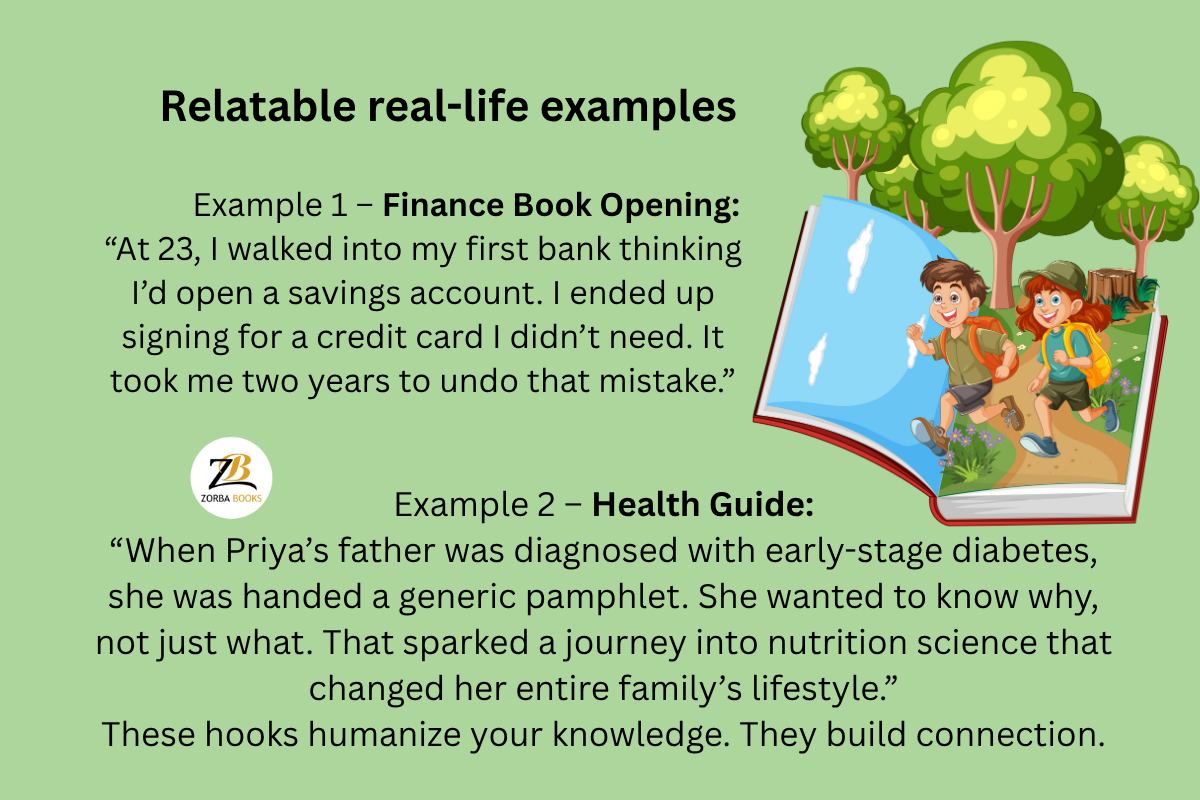
These hooks humanize your knowledge. They build connection.
3. Voice and tone
Books that sound like they were written by real people—not professors or bots—tend to do better, especially with Indian audiences.
4. Creative Nonfiction Tips for Indian Writers
1. Show, Don’t Just Tell
If you’re explaining historical events, recreate them with vivid imagery. Use weather, clothing, smells. Let the reader see 1947 Kolkata or 1984 Punjab. Instead of saying “students are stressed,” describe “a sleepless law student revising under flickering hostel lights.”
2. Break the Monotony
Use interviews, sidebars, bullet points, chapter quotes, and infographics to add rhythm to your book.
3. Let Your Voice Shine
Even serious nonfiction benefits from humor, opinion, and personal reflection—especially in contexts, where readers resonate with honesty.
4. Blend Research with Emotion
Cite your sources, but don’t drown your reader in citations. Use real stats alongside real stories.
Did you know? According to FICCI’s Publishing Sector Report (2022), books with hybrid formats—narrative paired with data—show higher retention and completion rates.
5. Table: Dry Facts vs Narrative Nonfiction Techniques
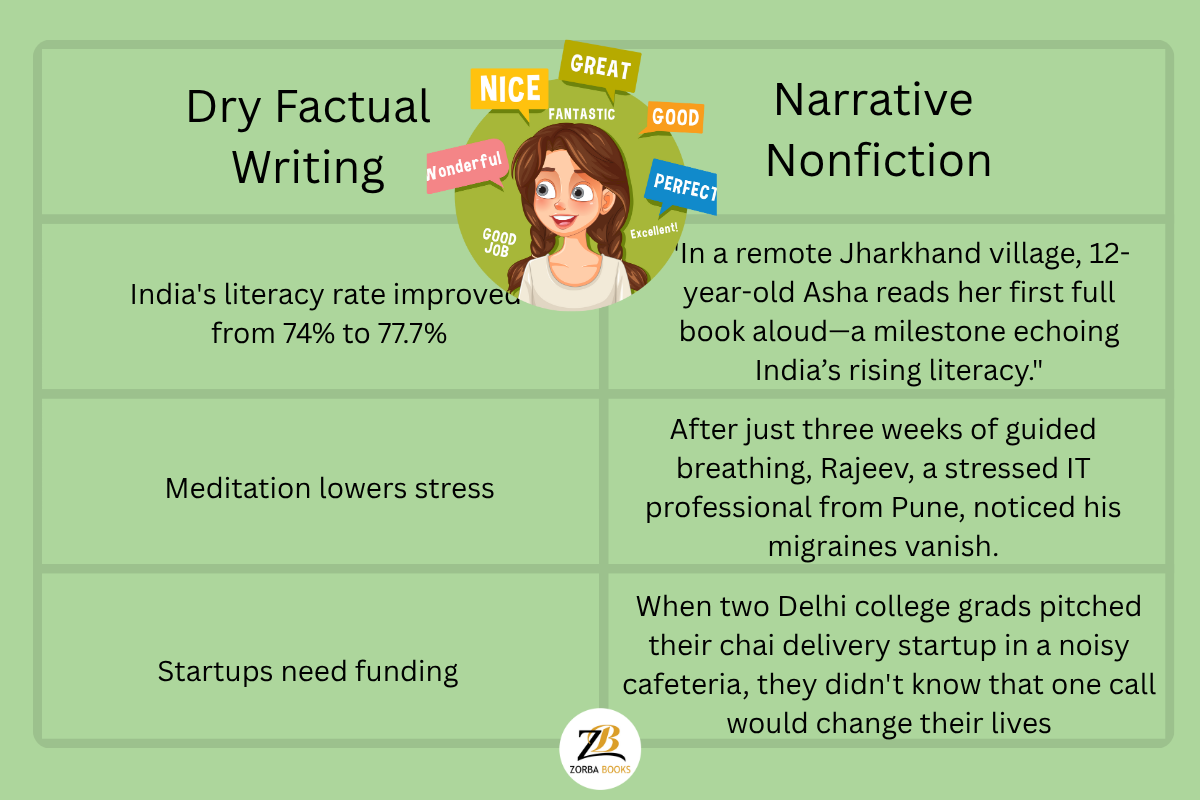
The data is the same, but the narrative technique brings it to life.
Authors Using Narrative Non-Fiction Techniques Effectively
- Sudha Murthy blends anecdotes, life lessons, and warmth in books like “Wise and Otherwise”.
- Rujuta Diwekar writes about health through case studies and cultural commentary, never just cold facts.
- Tamal Bandyopadhyay uses journalistic storytelling in books like “Bandhan: The Making of a Bank” to explain complex topics.
These authors prove that even banking or health can feel like page-turners with the right structure and style.
7. Turn Expertise into Engagement
If you’re an expert—a teacher, entrepreneur, doctor, or coach—your experiences can become stories that educate and entertain.
Instead of:
- Listing industry stats
- Giving lectures
- Summarizing trends
Try:
- Narrating a client journey
- Sharing a mistake you made
- Describing a “lightbulb moment”
This approach turns a flat topic into a creative nonfiction experience your readers won’t forget.
Zorba Books’ Tip for New Non-Fiction Writers
Many first-time authors over-research and underwrite. At some point, you have to stop collecting material and start shaping your narrative.
At Zorba Books, we recommend beginning with a 500-word chapter sample told through a story. This helps test your voice, hook, and confidence—before you dive into 40,000+ words.
8. Final Takeaways: Writing That Connects
- Stories stick; facts fade. Readers may forget stats but they’ll remember the story of a mother from Patna who used yoga to manage her diabetes.
- You don’t need to be famous to write nonfiction. You just need perspective, clarity, and storytelling intent.
- Don’t worry about being perfect. Be authentic. That’s what builds loyal readers.
Ready to Tell Your Story?
Whether you’re documenting your journey, your field, or your philosophy, don’t just inform—engage.
If you’re looking for expert guidance on transforming your nonfiction manuscript into a powerful narrative, from structure to publication, consider connecting with us at Zorba Books.
Share This Blog With a Fellow Writer
If you know someone working on a nonfiction book—whether it’s a memoir, professional guide, or short story-based nonfiction—send them this post.
Let’s help writers tell real stories in unforgettable ways.
Additional Reading: Selling-Your-First-100-Copies I Zorba Books