

Why it matters: Hybrid publishing bridges the gap between traditional and self-publishing, offering Indian authors the best of both worlds—professional support with creative control.
- Have You Published a Book… but Feel Like You’re Missing Out?
- What Exactly Is Hybrid Publishing?
- Operation Cost Overview in India
- Comparing Publishing Models
- What are the Hybrid Publishing Benefits for Authors?
- Types of Hybrid Publishing Models
- How Hybrid Publishing Works (Your 6‑Step Journey)
- Is Hybrid Publishing Beneficial for You?
- How to Pick a Reputable Hybrid Publisher
- Tips for Hybrid Publishing Success
1. Have You Published a Book… but Feel Like You’re Missing Out?
Your manuscript is finally ready. You’ve self-published or tried to approach a traditional publisher—but the next step feels unclear:
- “Can I still get professional editing, design, and marketing without giving up rights?”
- “Why is self-publishing so expensive, but traditional publishing so slow and uncertain?”
- “Is there a middle path where I keep creative control yet avoid hammering my budget?”
1. I’ve written my book—now what?
Many authors feel lost after finishing their manuscript. Should they pitch to a traditional publisher or go it alone?
2. Will I lose control over my book if I sign with a publisher?
Traditional publishing often means handing over rights and decisions. Is there a middle path?
3. Can I afford professional publishing services?
Self-publishing can be costly and overwhelming. Is there a model that shares the cost and offers expert help?
4. How do I ensure my book looks professional and reaches readers?
If these questions resonate, you’re not alone. In 2025, the benefit of hybrid publishing is that it delivers exactly that—bridging self-publishing freedom and traditional-quality support.
Authors want quality production and wide distribution—but without waiting years or navigating complex systems.
2. What Exactly Is Hybrid Publishing?
Hybrid publishing is a cost-shared publishing model in which authors invest in professional services—such as editing, design, and distribution—while retaining rights and earning higher royalties. It blends the credibility of traditional publishing with the flexibility of self-publishing.
It offers:
- Professional support (editing, cover design, typesetting)
- Clear creative control and rights retention
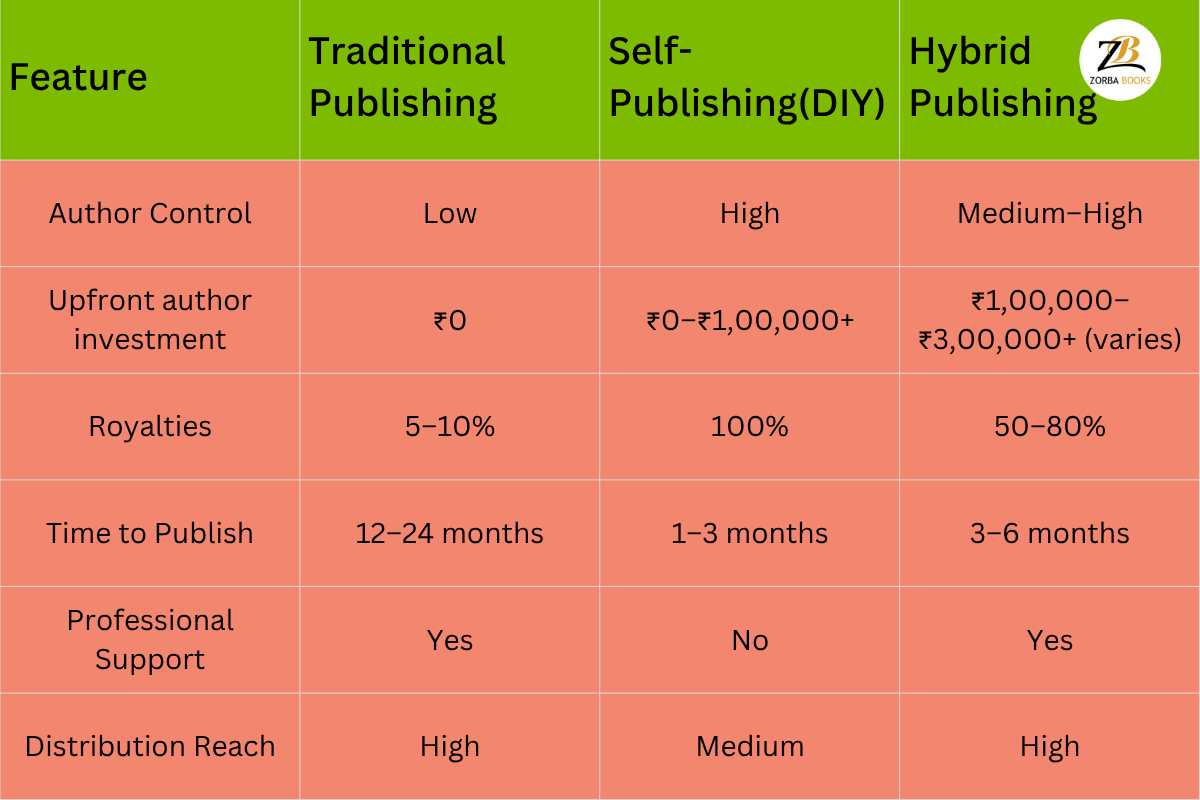
- Faster timelines (3–6 months vs 12–24 months with traditional)
- Better royalty splits (40–70% vs 7–10%)
- Stronger distribution in physical and digital marketplaces
If you’re asking “hybrid publishing vs self-publishing”, think of it as “self publishing + expert guidance.” Unlike assisted self-publishing, reputable hybrid publishers adhere to traditional publishing guidelines in evaluating manuscripts, providing editorial guidance, and ensuring both physical and digital distribution.
Source: Indian Publishing Trends Report, 2025
3. Operation Cost Overview in India
| Service | Typical Cost (₹) |
| Editing | 50,000–100,000 |
| Cover & Typesetting | 8,000–20,000 |
| ISBN + Setup | 5,000–10,000 |
| Printing & POD | 10,000–50,000 |
| Marketing Campaign | 50,000–200,000 |
| Total | ₹1,23,000–₹3,80,000 |
What does this mean for a first-time author?
The cost range above — ₹1,23,000 to ₹3,80,000 — represents the full spectrum from a lean, essentials-only publishing package to a comprehensive launch with a major marketing campaign. Most first-time authors do not need the upper end of this range. A realistic budget for a first book — covering professional editing, cover design, typesetting, ISBN, and distribution to Amazon, Flipkart, and the Zorba Store — typically falls between ₹50,000 and ₹1,00,000. The larger figures in the table reflect developmental editing and marketing campaigns, which are optional and can be added later once the book is published and gaining traction. The practical starting question is not “Can I afford ₹3.8 lakh?” but “What is the minimum I need to publish professionally?” — and for most authors, that answer is far more accessible than the upper figure suggests. Zorba Books offers transparent, itemised packages so you can see exactly what you are paying for and choose only what your book genuinely needs.
Indian Examples: Hybrid Publishing in Action
- A debut novelist Tamanna C from Mumbai partnered with Zorba Books publisher to release her book in English With shared investment, she retained rights and earned ₹1.2 lakh in royalties.
- A business author in Gurgaon used hybrid publishing to launch his book Enhancing Leadership Presence, with professional editing and a marketing tie-in. His book was featured on Amazon India’s Top 100 list.
4. Comparing Publishing Models
5. What are the Hybrid Publishing Benefits for Authors?
Market Shifts
India’s book market is projected to grow 19.4% CAGR through 2025, with non-traditional platforms accounting for 43% of new titles*
Online book sales now surpass 70% of total retail, powered by Zorba Books, Amazon, Flipkart, and niche digital platforms
1. Author-Led Empowerment
With faster publishing and greater control, independent creators are taking the centre stage, especially in genres like business, memoir, and fiction
2. Focus on ROI
3. A Polished Product
Writers who want a polished product without excessive upfront risk
4. Faster Turnaround
Authors can publish in 3–6 months, ideal for topical books or seasonal releases.
5. Author Branding
Hybrid publishing India allows authors to build their personal brand, with control over cover design, pricing, and marketing.
6. Multi-Channel Distribution
Books are available in online stores like Amazon and Flipkart, and in physical stores—bridging both worlds.
6. Types of Hybrid Publishing Models
| Model Type | Description | Best For |
| Service-Based | Pay for specific services (editing, design, etc.) | Authors with partial needs |
| Package-Based | All-in-one publishing bundles | First-time authors |
| Royalty-Split | Lower upfront cost, shared royalties | Authors with high sales potential |
7. How Hybrid Publishing Works (Your 6‑Step Journey)
- Initial Evaluation
Discuss your goals, draft sample pages, and align expectations. - Shared Investment
Decide on services—editing, cover, typesetting, ISBN, distribution, marketing. - Structured Workflow
Create timelines for deliverables, review cycles, and approvals. - Production
Gain polished copy editing, interior design, and book formatting expertise. - Market Launch
Distribution across platforms, metadata optimization, and strategic listing.
Promotional Push
Hybrid partners often assist with book review campaigns, media outreach, and launch strategies
8. Is Hybrid Publishing Beneficial for You? Ask Yourself:
- Do I want help but also want to own my book rights?
- Can I invest ₹50K–₹1L for a quality publishing experience?
- Do I want polished production matched with faster timelines?
- Am I ready to take part in marketing and promotion post-launch?
Answer “yes”? Then hybrid publishing India is likely your strongest fit.
9. How to Pick a Reputable Hybrid Publisher
✅ Transparent cost breakdown
✅ Real client testimonials
✅ Clear royalty structure
✅ No-pressure sales tactics
✅ Support for marketing including social media
Example providers include Zorba Books, which offers clear hybrid publishing packages, supportive editorial guidance, and listings across major Indian and global platforms.
10. Tips for Hybrid Publishing Success
- Self-edit before paying: polish grammar and flow
- Stay involved in design; visuals must reflect you
- Author your own marketing—partner, don’t abdicate
- Bundle freebies: one pager or a PDF excerpt works wonders
- Use video teasers: talk about your publishing journey
Choose the Publishing Path That Works for You
Ready to publish your book with confidence?
✅ Explore hybrid publishing models
✅ Retain your rights and creative control
✅ Get professional support without losing your voice
Hybrid publishing is more than a compromise—it’s a strategic choice for modern Indian authors.
Frequently Asked Questions About Hybrid Publishing in India
Yes. Rights retention is one of the defining features of hybrid publishing and what separates it most clearly from traditional publishing. You retain the copyright to your work. The publisher handles the production and distribution under an agreed service arrangement, but the book remains yours. Always confirm the rights clause in any publishing agreement before signing.
For a first-time author, a realistic budget for a professional hybrid publishing package — covering editing, cover design, typesetting, ISBN, and distribution — typically falls between ₹1,00,000 and ₹1,50,000. Larger figures (up to ₹3,80,000) reflect developmental editing and premium marketing campaigns that are optional and can be added later. Always ask for an itemised breakdown of services, so you know exactly what it covers.
Most hybrid publishers work to a timeline of 3 to 6 months from manuscript submission to published book. This is significantly faster than traditional publishing, which typically takes 12 to 24 months (and often longer for debut authors). The timeline depends on the complexity of your manuscript, the extent of editing required, and how quickly you respond to review cycles during the production process.
Hybrid publishing royalties for Indian authors typically range from 10% to 40% of net sales, compared to 7–10% with a traditional publisher. The exact percentage depends on your agreement and the platforms through which the book sells. With Zorba Books, royalties are clearly stated upfront with no hidden deductions — you can use the Zorba Royalty Calculator to estimate your earnings before committing to a package.
In pure self-publishing, the author sources, coordinates, and funds every element — finding a freelance editor, a cover designer, a typesetter, and managing distribution independently. In hybrid publishing, a professional publisher coordinates all of these elements under one roof, applies consistent quality standards, and provides guidance throughout. The cost may be similar, but hybrid publishing saves significant time, reduces risk, and typically produces a more polished result than a first-time author navigating self-publishing alone.
Yes. Reputable hybrid publishers in India distribute through all major online platforms — Amazon India, Flipkart, and the publisher’s own store — as well as through print-on-demand systems for physical copies. Ask any publisher you consider to confirm exactly which platforms your book will be listed on, and whether distribution is included in the package or charged separately.
Hybrid publishing is particularly well-suited to first-time authors who want professional support, faster timelines, and creative control — but who do not have the connections or platform to attract a traditional publishing deal. It removes the complexity of sourcing individual services while keeping the author in charge of their own book. The package-based model in particular is designed for first-time authors who want a clear, predictable process from manuscript to published book.
Look for a publisher that provides a transparent, itemised breakdown with no hidden fees; has verifiable author testimonials and published books you can examine; offers a clear royalty structure in writing; does not pressure you to sign quickly; and has genuine distribution partnerships with major platforms. Be cautious of publishers who promise bestseller status, charge for services that should be included, or are vague about where your book will actually be sold.
If this blog helped clarify your publishing options, share it with fellow writers. Let’s build a future where every author finds the right path to publish their story. Zorba Books is here to support your journey with ethical, transparent, and empowering publishing solutions.
If you’re still wondering how to start, here’s a step-by-step guide to publishing a book in India.
Want a deeper breakdown of self-publishing costs? Explore this detailed post.
Still considering full self-publishing? Read this to compare with the hybrid model.
