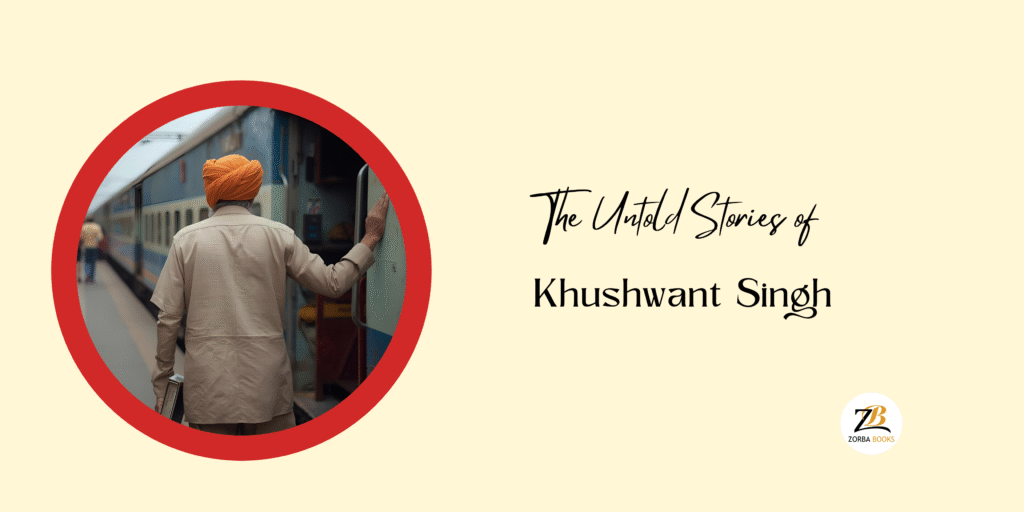
- Who Was Khushwant Singh?
- The Untold Stories of Khushwant Singh: Beyond Train to Pakistan
- Khushwant Singh’s Life Story
- Khushwant Singh’s Writing Philosophy and Daily Discipline
- Khushwant Singh lesser-known facts(FAQ)
Who Was Khushwant Singh?
Khushwant Singh was one of India’s most loved writers. When Khushwant Singh’s ashes were carried to his birthplace, Hadali in Pakistan, it marked the closure of an extraordinary circle—a return “home” after a lifetime spent bridging the borders between countries, cultures, and literary worlds. The public knew him as the irrepressible wit behind Train to Pakistan and With Malice Towards One and All, the “dirty old man” of Indian journalism, and the author who dared to return the Padma Bhushan. But the stories that shaped him, fueled his art, and defined his personal philosophy remain hidden beneath the headlines. There was much more to Khushwant than just books and jokes.

2. The Untold Stories of Khushwant Singh: Beyond Train to Pakistan
i Early Life: From Hadali to Lahore – Khushwant Singh’s Roots
Khushwant was born in 1915 in Hadali, a small town now located in Pakistan. His father, Sobha Singh, was a prominent builder—he constructed many famous landmarks in Delhi, including India Gate and parts of the presidential palace. Khushwant grew up watching his dad change the city while he dreamed of making his own mark with words, not bricks. Even after Partition, Khushwant never forgot where he was born, and that becomes clear in some of his most touching stories. Then he passed away in 2014, his ashes went all the way back to his birthplace in Pakistan.
ii The Builder’s Son: How Sobha Singh Shaped Delhi and His Son’s Destiny
Most people don’t realise how much Khushwant’s dad shaped Delhi. Sobha Singh was called “Adhi Dilli ka Malik” (the owner of half of Delhi) because he was behind the construction of iconic spots like India Gate, South Block, and Connaught Place. Khushwant used to live in a fancy apartment that his father built, called Sujan Singh Park — where he stayed all his life, despite being famous all over the country.
iii Khushwant Singh’s Literary Masterpieces: More Than Just a Train to Pakistan
Train to Pakistan: The Partition Novel That Changed Indian Literature
Published in 1956, Train to Pakistan remains Singh’s most iconic novel, depicting the chaos and tragedy during India’s partition in 1947 through the fictional village of Mano Majra. The novel’s vivid storytelling, stark realism, and social critique earned international acclaim and established Singh as a master of Partition literature
Other Khushwant Singh’s books
- A History of the Sikhs: Khushwant Singh’s Scholarly Masterwork (1963-2004): A scholarly two-volume history of Sikhism, based on original documents in Gurmukhi, Persian, and English.
- Delhi: A Novel (1990): After 25 years of meticulous research, Singh portrayed the city’s history across centuries through intertwining fiction and fact.
- The Company of Women (1999): An unapologetic exploration of sexuality, following businessman Mohan Kumar’s exploits after divorce, sparking both praise and controversy.
iv The Man Behind the Pen: Khushwant Singh’s Writing Style & Social Commentary
Indian writer Khushwant Singh’s writing style combined simplicity and clarity with sharp wit and honesty. He infused his Indian English literature with phrases from Punjabi and Urdu for authenticity. His satirical wit condemned social hypocrisies, religious fundamentalism, and political excesses. He believed in fearless realism—despite criticism—and was unafraid to speak about taboo subjects, including sexuality, which earned him the nickname “the dirty old man”. His social commentary was often laced with anecdotal stories drawn from personal experience, making his work relatable and impactful.
v Journalism and Editorial Influence: Revolutionising Indian Media
The Man Behind “With Malice Towards One and All”: Journalism Career
Khushwant Singh’s editorial career was as influential as his books. Beginning with All India Radio (1951), he later founded and edited Yojana (1951-1953), and became editor of The Illustrated Weekly of India (1969-1978). Under his leadership, the magazine’s circulation soared from 65,000 to 400,000, thanks to bold, provocative content. His famous column “With Malice Towards One and All” challenged political norms and societal taboos, cementing Singh’s reputation as India’s most fearless journalist.
3. Khushwant Singh’s Life Story
i The Untold Love Story: Khushwant Singh’s Marriage
Most people think Khushwant was a big flirt, always with women and cracking jokes. But behind his lively image, he was lonely. He married Kawal Malik in 1939, and they remained together for over 70 years. In Khushwant Singh biography he wrote that he lived a “life without love.”
ii The Final Journey: Khushwant Singh’s Ashes Return to Pakistan
When Khushwant was close to passing in 2014, he told his friends he wanted his ashes to go to Pakistan, to his hometown Hadali, where he was born. His daughter Mala made it happen. The ashes traveled across the border and were buried under a tree at his childhood school, with a plaque that says, “A Sikh, a scholar, and a son of Hadali.”
iii Friends Across Borders
Despite the pain of Partition, Khushwant never hated Pakistan. He said, “I feel like I have two nationalities.” He believed that good stories and friendships could build bridges, not walls. In fact, he often invited Pakistani writers and artists to India for his famous Kasauli Literary Festival.
iv Creating Santa-Banta: How Khushwant Singh Invented India’s Most Famous Jokes
You must have heard about Santa and Banta jokes. Well, guess what? Khushwant Singh, the writer, was the creator of those characters! He started writing jokes with Santa and Banta in the 1980s just for fun

4. Khushwant Singh’s Writing Philosophy and Daily Discipline
a Khushwant Singh Writer’s House and Routine
His apartment in Delhi is famous for its doorbell, which chimed, “Don’t ring unless you have an appointment!” He was very strict about his time. He used to wake up early, write every day, and only meet friends when he wanted. Despite being tough on schedule, he was warm and friendly when you finally got to see him.
b His Hillside Retreat: Kasauli
Khushwant loved spending time in Kasauli, a small hill station in Himachal Pradesh. Today, there’s a Khushwant Singh Literary Festival there, honoring his love for nature and stories.
c Controversies and Lawsuits
Khushwant wasn’t afraid of speaking his mind. He supported Sanjay Gandhi during the Emergency, which upset many.
d How He Wrote Every Day
Want to know his secret? Khushwant said: “Get up early, write, and don’t stop.” He believed a writer should be disciplined and keep practising — no excuses!
e What He Left Behind
Khushwant Singh isn’t just about his books. Khushwant Singh’s life story showed us that honesty, humour, and kindness can change the world.
f Awards, Controversies and the Padma Bhushan He Returned
- Padma Bhushan (1974), which he famously returned in 1984 following Operation Blue Star.
- Padma Vibhushan (2007)
- Punjab Rattan Award
His Legacy: A Fearless Voice in Indian Literature & Journalism
Khushwant Singh’s influence extends beyond Indian English literature. He challenged societal norms, championed secularism, and helped bridge the cultural divides between India and Pa autobiography, Truth, Love, and a Little Malice, offers candid insights into his life and beliefs. His vision of Indo-Pak friendship remains inspirational, demonstrated through ongoing literary festivals and his personal relationships across borders.
5. Khushwant Singh lesser known facts(FAQ)
Q: Was Khushwant Singh really born in Pakistan?
Yes! He was born in Hadali, which is now in Pakistan. His ashes are there too, in his homeland. Q: Did he create Santa-Banta jokes?
Absolutely! He started those jokes in the 1980s, and they became super famous.
Q: Why did he return his Padma Bhushan?
He did it in 1984 to protest the Army’s attack on the Golden Temple. He believed it was wrong. Q: Was Khushwant Singh a ladies’ man?
Not really. He was married all his life, but he said he was lonely and wished for real love.
Want to Know More?
Khushwant Singh’s autobiography: Truth, Love and a Little Malice
His famous book: “Train to Pakistan”
The story of Soban Singh and Delhi’s history
His colorful take on Indo-Pak friendship
Khushwant was more than just a witty writer. He was a man who believed in truth, friendship, and humor — even when life was tough. Khushwant Singh life story reminds us that honesty and kindness are the best legacy of all.
This comprehensive guide to Khushwant Singh was researched and written by the editorial team at Zorba Books, India’s leading publishing services company specialising in author support, book marketing, and literary content creation.
If you found some new things today, share this story with your friends!
Insights, advice, little known snippets from the lives of well-known Indian authors and Zorba authors
I like the efforts you have put in this, regards for all the great content.
Very well presented. Every quote was awesome and thanks for sharing the content. Keep sharing and keep motivating others.