
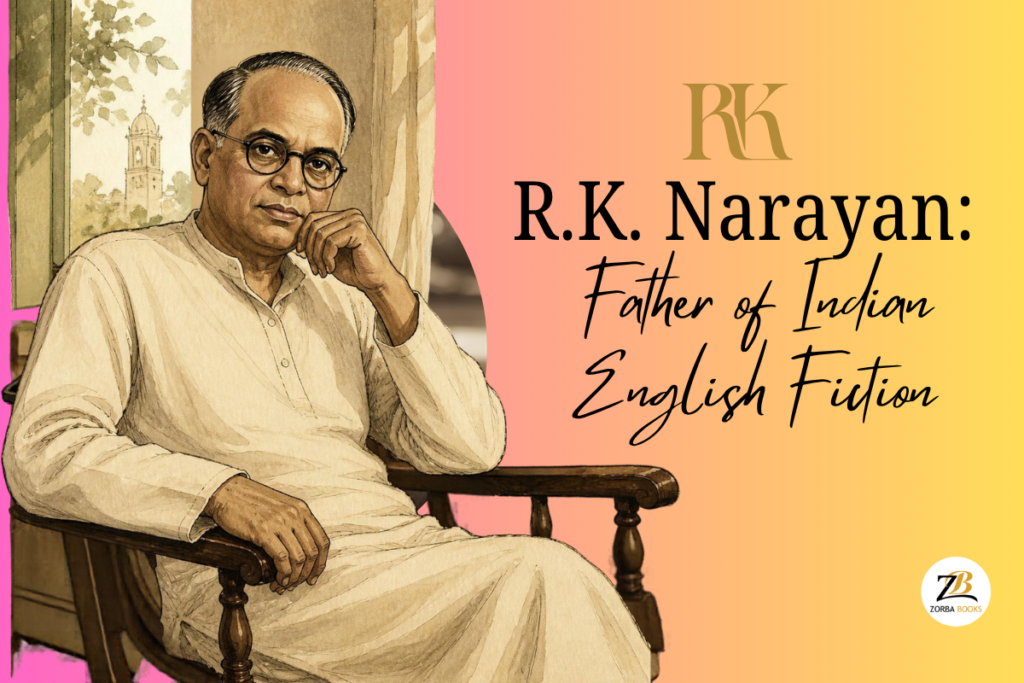
Ask a room of Indian readers to name one writer who made English feel like their own, and R.K. Narayan is often the first name to come up.
He is regularly called the father of Indian English fiction, a phrase that appears on book covers and in classrooms, yet few people can say exactly where it comes from or what it really means.
The title is not an official honour, and he was not even the first Indian to write a novel in English, so the story behind it is more interesting than the label suggests.
This guide explains why he earned the title, which books to read first, how he compares with Mulk Raj Anand and Raja Rao, and what Indian writers today can learn from him.
| Key Takeaways 1. “Father of Indian English fiction” is a popular title given by readers and critics, not an official honour or award. 2. Narayan was not the first Indian novelist in English, since Bankim Chandra Chatterjee’s Rajmohan’s Wife (1864) is generally considered the first. 3. His influence rests on making Indian English fiction rooted in everyday life, written in clear, simple language, and enjoyable for readers everywhere. 4. Malgudi, the fictional South Indian town in his stories, is the heart of his work. 5. Swami and Friends, Malgudi Days, and The Guide are the most popular starting points for new readers. 6. Narayan, Mulk Raj Anand, and Raja Rao are often called the founding trio of Indian English fiction, each with a different focus. |
1. Why Is R.K. Narayan Called the Father of Indian English Fiction?
R.K. Narayan earned the title because he showed that Indian lives, told in plain English and without exoticising them, could stand beside any literature in the world.
Born in Madras in 1906, he began publishing in the 1930s, when Indian writing in English was still a small and uncertain field.
Here is what made his contribution so lasting:
- A fictional town that felt real. Malgudi gave Indian English fiction a lasting setting, filled with clerks, teachers, students, and shopkeepers that readers recognised.
- Plain, unforced English. His clean prose showed that Indian stories did not need ornate language to reach readers across the world.
- Ordinary people at the centre. He wrote about everyday hopes and small failures, with gentle humour and without turning India into a spectacle.
- A long career. He kept publishing for several decades, so generations of readers grew up with his books.
- A champion abroad. Graham Greene supported his early work, which helped Swami and Friends reach readers in England.
His honours include the Sahitya Akademi Award for The Guide, the Padma Bhushan, the Padma Vibhushan, and a nominated seat in the Rajya Sabha.
i Is “Father of Indian English Fiction” an Official Title?
No, it is not an official title, and it is not linked to any award or institution.
It is a popular description used by critics, teachers, and readers to recognise his influence, so it is best treated as a tribute rather than a formal designation.
ii Was R.K. Narayan the First Indian to Write a Novel in English?
No, because Bankim Chandra Chatterjee’s Rajmohan’s Wife, published in 1864, is generally considered the first Indian novel in English.
Narayan’s claim to the title rests on influence and popularity, not on being first, which is why the phrase is better read as a tribute than as a historical fact.
R.K. Narayan Books to Read First
| If you are new to R.K. Narayan, start with Swami and Friends or Malgudi Days for his gentle humour, then move to The Guide, his best-known novel, once you want something deeper. |
The table below shows where each popular book fits:
| Book | Year | Why Start Here |
| Swami and Friends | 1935 | His first novel, a funny and warm story of a schoolboy that introduces Malgudi. |
| Malgudi Days | 1943 | A collection of short stories, ideal if you prefer shorter reads. |
| The Financial Expert | 1952 | A sharp, ironic story of ambition and money, for readers who enjoy social comedy. |
| The Guide | 1958 | His most celebrated novel, about a tour guide who becomes an unlikely holy man. |
| The Man-Eater of Malgudi | 1961 | A darker, more dramatic tale, for readers who want a change from the gentle comedies. |
Readers drawn to devotional themes can also try his condensed retellings of the Ramayana and the Mahabharata, which are written in the same simple, accessible English.
Is Malgudi a Real Place?
Malgudi is an imaginary South Indian town, although readers have long tried to match it to real places.
The 1980s television series Malgudi Days was filmed in Agumbe, Karnataka, and The Guide was also adapted into a well-known Hindi film in 1965.
R.K. Narayan vs Mulk Raj Anand vs Raja Rao
Narayan is usually mentioned alongside Mulk Raj Anand and Raja Rao, and together the three are often called the founding trio of Indian English fiction.
They all began publishing in the 1930s, but each wrote about India in a very different way, as the table shows:
| R.K. Narayan | Mulk Raj Anand | Raja Rao | |
| Known for | Malgudi and everyday small-town life | Social realism and the lives of the oppressed | Philosophy, tradition, and Indian spiritual thought |
| Landmark early novel | Swami and Friends (1935) | Untouchable (1935) | Kanthapura (1938) |
| Tone | Gentle, ironic, and humorous | Passionate and socially urgent | Reflective and lyrical |
| Style of English | Simple and clear | Earthy and direct | Echoes the rhythms of Indian speech |
| Good entry point | Swami and Friends | Untouchable | Kanthapura |
Each of them opened a different door, which is why many readers see Narayan as the one who made Indian English fiction feel at home with a wide, general audience.
What Can New Indian Authors Learn From R.K. Narayan?
Narayan’s career offers practical lessons for anyone writing a first book today:
- Write about the place and people you know best, because specific details feel more truthful than grand ideas.
- Build a world you can return to, since a familiar setting like Malgudi lets readers settle in and come back for more.
- Let character carry the story instead of relying on dramatic plots or complicated language.
- Keep going through early setbacks, since his first novel struggled to find a publisher before Graham Greene helped it reach print.
Do You Need Fancy English to Write Well?
No, and Narayan is the best proof, because his plain, clear sentences have stayed readable and popular for decades.
If you are worried about your English, focus on honest detail and clear storytelling, which matter far more than ornate vocabulary.
Have a Story From Your Own Malgudi?
Every Indian town, mohalla, and family has stories worth telling, and Narayan’s life is a reminder that the stories closest to you can reach the widest audience.
If you are writing your first book and want to talk through your publishing options, the Zorba Books team can walk you through the process, from manuscript to print.
| Book a Free Publishing Consultation → www.zorbabooks.com/contact |