
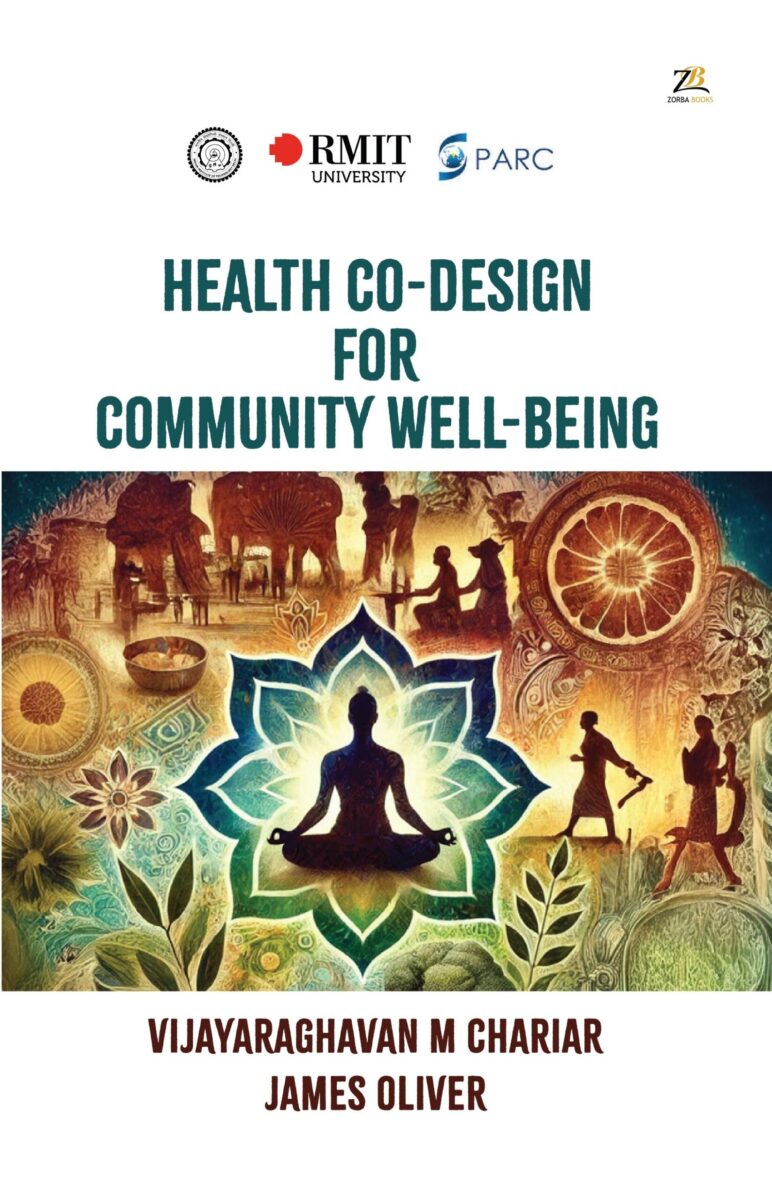
What if the best healthcare doesn’t come from a hospital — but from the community itself?
For decades, India’s health systems have been built from the top down: policies drafted in offices, solutions delivered to villages, and communities treated as passive recipients of care. But what happens when the people living with chronic illness, cultural wisdom, and daily resilience are invited to co-create the solutions?
Health Co-Design for Community Well-Being flips the script. Born from a two-year SPARC initiative funded by the Ministry of Education, Government of India, this groundbreaking collaborative monograph brings together voices rarely heard in the same conversation — Ayurveda and homeopathy practitioners, public health educators, policy experts, artists, and community members — to show how health can be rebuilt as a shared practice, not a delivered service.
Why This Book Changes the Conversation
Plurality of Knowledge
Biomedicine doesn’t have to stand alone. This book demonstrates how integrating Ayurveda, yoga, folk healing traditions, and community practices with modern health science creates richer, more culturally rooted solutions.
Participatory Innovation
Move beyond top-down prescriptions. Learn how dialogue, partnership, and co-design transform healthcare from a transaction into a relationship — where communities shape the systems that serve them.
Creative Healing
Discover how music, dance, and cultural practices aren’t just “adjuncts” to healthcare — they’re powerful tools for building resilience, fostering connection, and sustaining well-being in ways medicine alone cannot.
Community Agency
From rural villages to urban neighbourhoods, real communities are defining their own health futures. Case studies show how co-design transforms the management of chronic conditions like diabetes into shared journeys of empowerment through food traditions, yoga, and peer support.
Rethinking Policy
For policymakers, this book offers a roadmap toward frameworks that support distributed leadership, local knowledge, and trust-building — essential for India’s health transformation.
Who Should Read This Book
This monograph is essential reading for:
-
Public health researchers and practitioners seeking participatory approaches grounded in Indian contexts
-
Policymakers and government officials working on health system reform
-
Ayurveda, yoga, and traditional medicine practitioners looking to bridge their knowledge with modern frameworks
-
Academic researchers in design, social sciences, and health studies
-
NGO workers and community organizers building health initiatives at the grassroots level
-
Students in public health, social work, and development studies
-
Anyone interested in how communities can reclaim ownership of their well-being
The Book That Invites You In
Rather than offering a single blueprint, Health Co-Design for Community Well-Being invites scholars, practitioners, and policymakers to embrace co-learning and co-creation. It envisions health not just as a service delivered but as a living practice sustained through relationships, cultural wisdom, and collective imagination.
Ready to see healthcare differently? Add this book to your library today and join the movement toward community-rooted health.
6. ABOUT THE AUTHORS
Prof. Vijayaraghavan M. Chariar
Faculty, Indian Institute of Technology (IIT) Delhi
Prof. Vijayaraghavan M. Chariar is a distinguished faculty member at IIT Delhi whose work spans Traditional Knowledge Systems, Design for Sustainability, Ecological Sanitation, Appropriate Housing, and Joyous Leadership. Though originally trained in experimental materials science, he has dedicated the past two decades to experiential, learner-centred pedagogy that has inspired hundreds of students toward social entrepreneurship. His Teaching Excellence Award from IIT Delhi (2011) and Fulbright scholarship at Arizona State University (2012–13) reflect his impact as an educator. Beyond academia, Prof. Chariar serves as Chairman of IIT Delhi’s award-winning sanitation start-up, Ekam Eco Solutions, and mentors multiple social ventures through JoyIsYou. His research group, Frugal Innovation JoyLab, collaborates directly with farmers, artisans, and forest-dwelling communities to co-create culturally grounded innovations. He is a sought-after speaker on sustainability, start-ups, and self-discovery, and the author of numerous patents, publications, and design registrations.
James Oliver
Associate Professor, School of Design, RMIT University, Melbourne
James Oliver is a transdisciplinary educator, cultural collaborator, and researcher with over 20 years of experience spanning the public sector, arts, and well-being. His work sits at the intersection of community enquiry, cultural practice, and Indigenous research — drawing from his formative understanding of place, land, and language within his native community in the Scottish Hebrides. James has collaborated with practitioners and educators across Australia, Canada, Europe, India, and Japan, bringing a truly global perspective to his research on community health and co-design. As an Associate Professor at RMIT University’s School of Design, he continues to advance “practice as research” methodology, with a particular focus on Indigenous Practice Research in international contexts.
Browse books on health
“Are you a doctor or medical professional considering publishing a book? Read our guide: How Indian Doctors and Medical Professionals Can Publish a Book.”







Reviews
There are no reviews yet.