
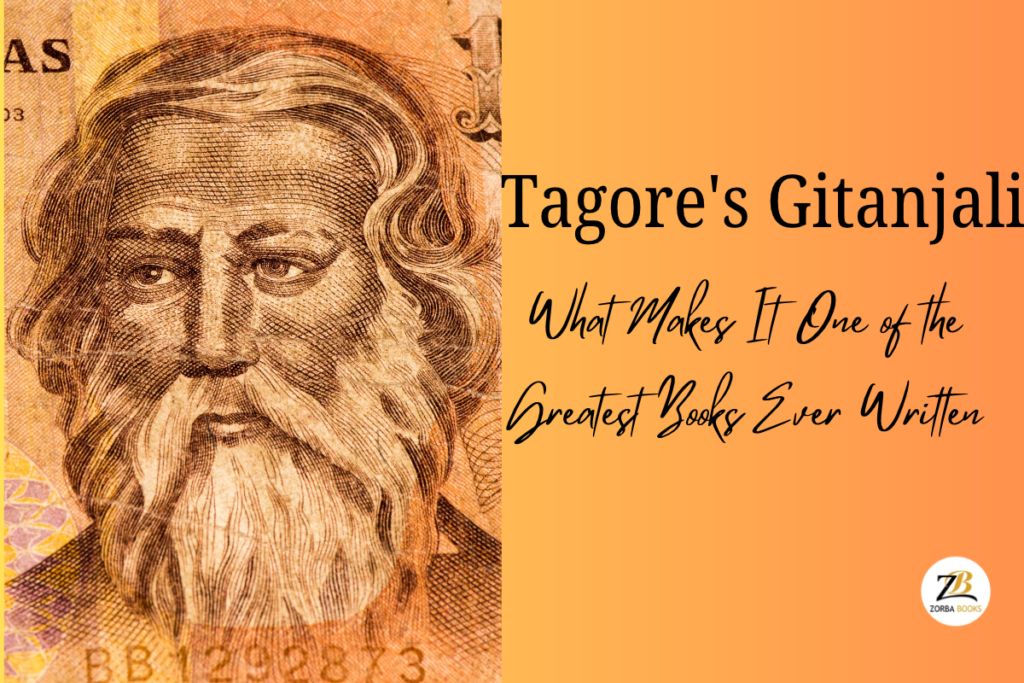
Over a century after it was first published, Gitanjali is still read, sung, quoted, and taught, which is a rare achievement for any book of poems.
Rabindranath Tagore’s collection won him the 1913 Nobel Prize in Literature, yet its real power lies in how personal and quiet its poems feel, as if the poet were speaking directly to you.
For readers who have only met a line or two in a school textbook, the book can also raise questions about its title, its different versions, and why so many people call it one of the greatest ever written.
This guide explains what Gitanjali is, what its poems are about, how the English version came to be, and how to read it for the first time.
Key Takeaways
- Gitanjali means “song offerings”, and it is a collection of devotional poems and songs by Rabindranath Tagore.
- Tagore won the 1913 Nobel Prize in Literature and became the first non-European to win any Nobel Prize.
- The Bengali Gitanjali (1910) and the English Gitanjali (1912) are different books, and the English version draws on several Bengali collections.
- Its main themes are devotion, humility, nature, death and renewal, and freedom, all expressed in simple language.
- Critics note that the English prose cannot fully carry the music of the original Bengali songs.
- The best way to start is a few poems at a time, along with listening to Rabindra Sangeet to feel the original songs.
Why Is Gitanjali Famous? What Makes It One of the Greatest Books Ever Written
Gitanjali is famous because it won Rabindranath Tagore the 1913 Nobel Prize in Literature, and it has endured because its simple, deeply personal poems about devotion, nature, and freedom still speak to readers across cultures.
The title means “song offerings”, and it describes poems offered to the divine in the spirit of an offering rather than a performance.
These are the main reasons readers and critics give for its lasting place in world literature:
- Global recognition. The 1913 Nobel Prize put Indian literature on the world stage and made Tagore the first non-European to win any Nobel Prize.
- Universal themes. Love, humility, loss, and the search for meaning are felt by readers of every background.
- Simple, direct language. The poems speak plainly, which is why they reach people who do not usually read poetry.
- A voice that feels personal. The poet speaks to the divine like a close companion, which makes the poems feel intimate rather than distant.
- A living tradition. The songs are still sung, recited, and taught more than a century later.
- Reach through translation. The English version carried Tagore’s voice to readers around the world.
Is Gitanjali Really One of the Greatest Books Ever Written?
Greatness is always a matter of judgment, but Gitanjali’s Nobel recognition, its influence, and its lasting readership make a strong case.
Not everyone agrees on every point, since some Bengali readers feel the English prose loses the music of the original songs, and some critics argue that Western readers saw Tagore too narrowly as a mystic.
These views are worth knowing, because they show that the book is still being discussed rather than simply admired.
Gitanjali Summary and Themes
Gitanjali is a collection of devotional poems and songs in which the speaker offers love, humility, and longing to a divine presence found in nature, in everyday life, and in the human heart.
The book has no single plot, so it is best understood through its recurring themes, which the table below sets out:
| Theme | What It Explores |
|---|---|
| Devotion and surrender | Giving oneself to the divine with love and humility |
| The divine in everyday life | Finding the sacred among ordinary people and daily work, not only in temples |
| Nature | Rivers, seasons, and light as signs of a larger presence |
| Death and renewal | Meeting death with calm and seeing it as part of life |
| Freedom | A free mind and a free country, as in the well-known poem 35, “Where the Mind Is Without Fear” |
| Humility | Letting go of pride and ego |
Which Traditions and Music Shaped Gitanjali?
Tagore drew on Bhakti devotional poetry, the Upanishads, Vaishnava poetry, and the songs of the Bauls, who are wandering Bengali singers, and blended them into his own voice.
Many of the Bengali poems are songs, and they are still sung as Rabindra Sangeet, which is why listening to them can be as rewarding as reading them.
Gitanjali Bengali vs English: How the Nobel-Winning Book Came to Be
Many readers do not realise that the Bengali Gitanjali and the English Gitanjali are two different books, so the table below shows how they compare:
| Bengali Gitanjali | English Gitanjali (Song Offerings) | |
|---|---|---|
| Published | 1910 | 1912, in London |
| Number of poems | About 157 | 103 |
| Form | Poems and songs in Bengali | Prose-style English translations by Tagore |
| Source | The original collection | Drawn from Gitanjali and several of his other Bengali collections |
| Introduction | None | Written by W.B. Yeats |
Here is how the book travelled from Bengal to the Nobel Prize:
- In 1910, the Bengali Gitanjali was published in Bengal.
- In 1912, Tagore translated a selection into English and travelled to London, where the painter William Rothenstein helped introduce the poems to Yeats and other writers.
- Also in 1912, the English collection was published in London as Song Offerings, with an introduction by Yeats.
- In 1913, Tagore received the Nobel Prize in Literature, which recognised his poetry as presented in his own English translation.
- In the years that followed, the book was translated into many other languages and reached readers worldwide.
A popular story says that Tagore once left his briefcase with the manuscript on the London Underground and got it back from lost property.
Why Did the Nobel Prize Matter for India?
It came while India was under colonial rule, and it showed that Indian writing could be recognised on the world stage on its own terms.
For many readers, it also became a source of pride in Indian languages and a reminder that great literature can come from anywhere.
Did Tagore Translate Gitanjali Himself?
Yes, Tagore translated the English version himself, choosing a selection of his Bengali songs and poems and rendering them into prose-style English.
Friends in London read and encouraged the work, and Yeats was among its earliest champions, but the translation itself is Tagore’s own, which is part of what makes the book so remarkable.
How to Read Gitanjali: A Guide for First-Time Readers
Many readers hesitate before picking up Gitanjali, so the table below matches common hurdles with a simple way to approach each one:
| Reader Hurdle | How to Approach It |
|---|---|
| It feels abstract | Read one or two poems at a time, and notice the images before trying to decode the meaning |
| Which edition to choose? | Pick a clear English edition with notes and an introduction, and check the edition details before you buy |
| English or Bengali? | Start with the English, then listen to Rabindra Sangeet versions to hear the music of the original |
| I am not religious | Read the poems as expressions of longing, humility, and wonder at nature, rather than as doctrine |
| Where do I begin? | Start with a few well-known poems, such as poem 35, and then read in order |
Tagore’s original works are generally in the public domain, but individual translations, introductions, and edited editions may have their own rights, so check before reusing any text, as explained in our guide to copyright for books in India.
Writers can also learn a good deal from the way Gitanjali came to be:
- Write plainly, because simple language carried Tagore’s poems further than ornate phrasing could.
- Write from your own culture and language, since specific places and traditions often feel universal.
- Consider translation, as Tagore’s own English version carried his work to readers worldwide.
- Share your work with trusted readers, since encouragement from friends helped Gitanjali reach its audience.
Have a Poem, a Story, or a Translation of Your Own?
Tagore’s journey shows that work written in one language and rooted in one place can reach readers everywhere.
If you are a poet, translator, or regional-language author preparing to publish, the Zorba Books team can talk through your options with you, from manuscript to print.
Book a Free Publishing Consultation → www.zorbabooks.com/contact
Why Is R.K. Narayan Called the Father of Indian English Fiction?